Discover how ink is made, explore the key stages of ink manufacturing, and learn how mixing, dispersion, milling, and filtration equipment help achieve consistent color, particle size, and product quality.
Ink plays an essential role in printing, packaging, writing, and many industrial applications. From colorful product labels to high-quality commercial prints, manufacturers rely on carefully formulated ink to achieve consistent colors, reliable performance, and excellent print quality. But how is ink made, and what role does industrial mixing equipment play in the production process?
The answer depends on the type of ink, its ingredients, and its intended application. Some formulations require pigment dispersion and milling, while others rely on dissolved dyes or specialized liquid carriers. In each case, manufacturers must select appropriate raw materials and control the production process to achieve the desired results.
This guide explains how ink manufacturers select ingredients, prepare formulations, mix and disperse colorants, control product quality, and choose industrial mixing equipment. It also explores different types of ink and the key factors that influence equipment selection.
Key Takeaways
Ink formulations typically combine colorants, liquid carriers, resins or binders, and functional additives.
Pigment-based inks require effective wetting and dispersion to achieve consistent color and performance.
Ink manufacturing may involve mixing, milling, filtration, quality control, and packaging, depending on the formulation.
High shear mixers can improve pigment dispersion and powder incorporation, while milling equipment may provide additional particle-size reduction when necessary.
Vacuum mixing, inline homogenization, and batch mixing serve different processing requirements.
Manufacturers should evaluate ink properties, batch capacity, target particle size, and production objectives before selecting equipment.
1. What Is Ink, and What Is It Made Of?
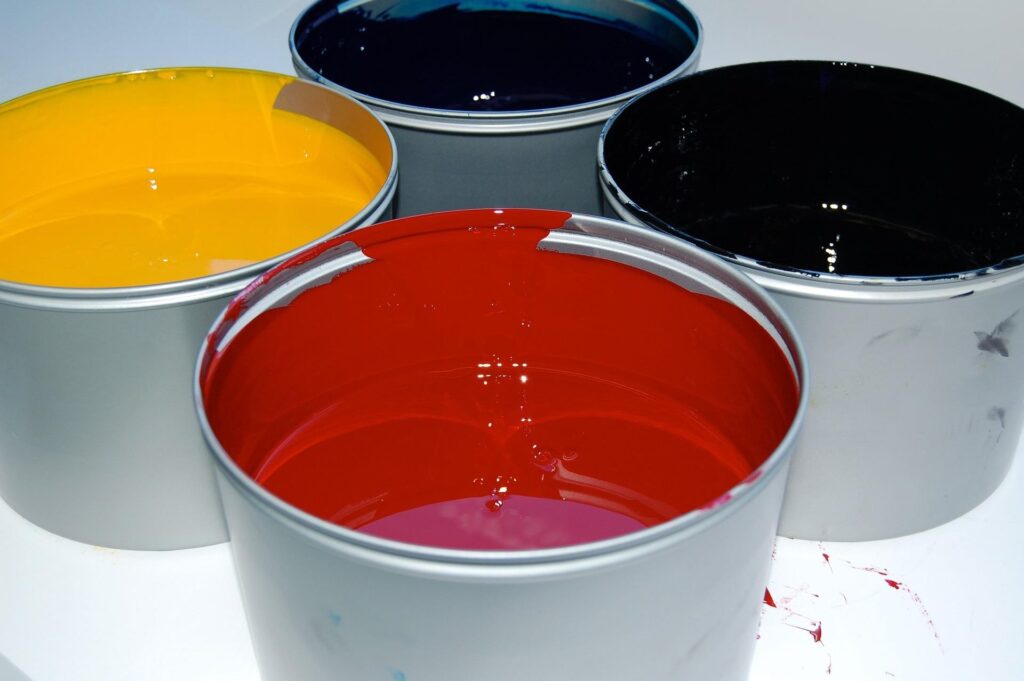
Ink is a liquid, paste, or specialized material that transfers color or other functional properties onto a surface. Manufacturers formulate different inks for applications such as commercial printing, packaging, inkjet printing, writing instruments, and industrial marking.
Although ink formulations vary considerably, most rely on several fundamental ingredient categories
1.1 What are the Main Ingredients in Ink?
The formulation determines the exact ingredients and their proportions. However, most conventional liquid inks use some combination of the following materials.
1. Pigments or dyes
Colorants provide the desired color. Pigments generally exist as solid particles dispersed throughout a liquid carrier, whereas dyes typically dissolve in a suitable medium.
2. Solvents or liquid carriers
The carrier provides the liquid medium for the formulation. Depending on the ink type, it can influence viscosity, flow, drying behavior, and compatibility with other ingredients.
3. Resins and binders
Resins and binders help the ink adhere to the printing surface and contribute to film formation and other performance characteristics.
4. Varnish
In certain printing ink formulations, varnish acts as a vehicle for pigments and helps establish the ink's wetting, flow, and printing properties. A varnish may contain resins, solvents, and other additives.
5. Functional additives
Manufacturers add specialized ingredients to achieve particular properties, such as foam control, moisture retention, microbial control, gloss, or water resistance.
Each ingredient serves a specific purpose. Therefore, ink manufacturers must consider compatibility between the components rather than simply combining them in a mixing tank.
1.2 What Is Varnish in Ink Manufacturing?
Varnish plays an important role in many conventional printing ink formulations.
A typical varnish system combines resins, solvents, and selected additives to create a suitable liquid vehicle. This vehicle helps wet pigment particles, supports pigment dispersion, and influences how the finished ink performs during printing.
Varnish can contribute to several important functions:
Pigment wetting: It helps the liquid phase contact the pigment surface.
Pigment binding: Its resin system can help the colorant adhere to the printing substrate.
Flow and printability: Its composition influences viscosity, transfer behavior, and other printing characteristics.
Film formation: Suitable resin systems help develop the required film properties after application.
However, not every ink uses a separately prepared varnish. Water-based, solvent-based, and other ink systems may follow different formulation and manufacturing routes.
For this reason, manufacturers should select a varnish system according to the ink chemistry and the final application.
1.3 What Is the Relationship Between Pigments and Varnish?
Igments provide color, but their presence alone does not guarantee a uniform ink. Manufacturers must distribute the particles throughout the carrier and control unwanted agglomeration.
During production, the liquid vehicle must wet the pigment surface before the mixing and dispersion process can effectively distribute the particles. Poor wetting may lead to floating powder, persistent agglomerates, or inconsistent color.
A suitable dispersion process helps manufacturers:
Incorporate pigments into the liquid phase.
Improve pigment wetting and distribution.
Reduce unwanted agglomerates.
Achieve more consistent color and texture.
Prepare the mixture for further processing when necessary.
High shear mixing can provide intense mechanical action to help disperse pigments. Nevertheless, the required equipment depends on the initial pigment condition, formulation, and target fineness. Some inks also require dedicated milling equipment to achieve their final specifications.
1.4 What Is Natural Ink, and How Does It Differ from Industrial Ink?
Natural ink makers extract color from materials such as flowers, leaves, bark, berries, roots, nuts, and certain kitchen scraps. Traditional recipes may use water, oil, or alcohol as an extraction medium and natural binders such as gum arabic to improve application properties.
A basic natural ink formulation may combine:
Plant-derived color + a suitable liquid medium + a binder
Some formulations also use modifiers to adjust color and preservatives to help control microbial growth.
The production approach differs from conventional industrial ink manufacturing in several ways.
Factor
Natural ink making
Industrial ink manufacturing
Color sources
Plant extracts and other natural materials
Pigments, dyes, and other formulation-specific colorants
Extraction
May involve soaking, heating, or other extraction methods
Depends on the selected colorant and formulation
Processing
Often uses small batches and manual techniques
May use controlled mixing, dispersion, milling, and filtration
Quality control
Often emphasizes color variation and artistic results
Commonly emphasizes defined specifications and batch consistency
Equipment
Basic extraction vessels, strainers, and containers
Industrial mixers and other process equipment selected for the formulation
Natural materials can produce distinctive colors, but their performance varies with the source material and extraction conditions. Manufacturers should not assume that natural extracts automatically provide the lightfastness, storage stability, or printing performance that an industrial application requires.
2. How Is Ink Made? The Complete Manufacturing Process
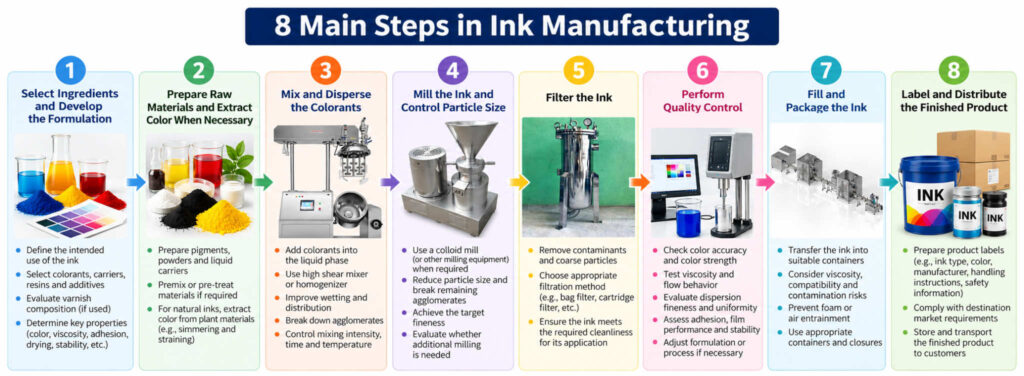
Step 1: Select Ingredients and Develop the Formulation
First, manufacturers define the intended use of the ink. Packaging ink, inkjet ink, and decorative printing ink may require different flow properties, drying behavior, adhesion, and color performance.
The formulation team selects appropriate colorants, carriers, resins, and additives according to these requirements.
For formulations that use varnish, the team also evaluates the varnish composition and its compatibility with the selected pigment.
Key considerations include:
Desired color and color strength.
Viscosity and flow characteristics.
Compatibility between ingredients.
Adhesion to the intended substrate.
Drying or curing requirements.
Storage stability and application conditions.
A well-designed formulation provides the foundation for the subsequent manufacturing process.
Step 2: Prepare Raw Materials and Extract Color When Necessary
Next, operators prepare the raw materials for processing.
Industrial pigment systems may require powder preparation, premixing, or other handling steps before dispersion. Manufacturers also prepare the liquid carrier and other ingredients according to the formulation.
Natural ink production follows a different route when the colorant comes from plant materials. For example, an artisan may simmer suitable plant material in water, test the developing color, and strain the liquid to remove plant residue.
The extraction time and conditions vary with the material. Some plants release color relatively quickly, while certain roots and bark require longer extraction.
However, natural color extraction does not replace pigment dispersion in conventional industrial ink manufacturing. Each process addresses a different material-processing requirement.
Step 3: Mix and Disperse the Colorants
Mixing and dispersion represent critical operations in many pigment-based ink formulations.
During this stage, the liquid phase contacts the colorant, and mechanical action helps distribute the ingredients throughout the mixture. For powder-based systems, effective wetting helps the liquid penetrate the powder and contact individual particles or agglomerates.
Manufacturers may use a batch high shear mixer, an inline homogenizer, or a combination of equipment depending on the formulation.
The main objectives include:
Incorporating powders into the liquid phase.
Improving pigment wetting.
Promoting uniform color distribution.
Reducing unwanted agglomerates.
Achieving the required intermediate consistency.
For ink systems that use varnish, the process may involve preparing the varnish first and then incorporating the pigments. Other formulations follow different sequences.
Operators must also control ingredient addition, mixing intensity, processing time, and temperature when these factors influence product quality.
Step 4: Mill the Ink and Control Particle Size
Some ink formulations require additional milling after the initial mixing and dispersion stage.
Milling equipment applies mechanical forces to reduce particle size or break down remaining agglomerates. The required treatment depends on the colorant, formulation, and target fineness.
This step becomes particularly important when the application requires tight control over particle characteristics, such as certain inkjet formulations.
High shear mixing and milling perform related but different functions. A high shear mixer can improve dispersion and break down some agglomerates, but it does not automatically replace a dedicated mill.
Manufacturers should evaluate the actual dispersion results before deciding whether the process requires additional milling.
Step 5: Filter the Ink
After mixing and any necessary milling, filtration can remove unwanted contaminants or coarse particles.
The appropriate filtration method depends on the ink formulation, particle characteristics, and end use. For example, applications with sensitive printing components may require particularly careful control of oversized particles.
Filtration should complement the upstream process rather than compensate for inadequate dispersion. If the mixture contains persistent agglomerates, operators may need to address the mixing or milling conditions as well.
Step 6: Perform Quality Control
Quality control helps manufacturers verify that the ink meets the requirements of its intended application.
Depending on the product, the inspection process may include:
Color accuracy and color strength.
Viscosity and flow behavior.
Dispersion fineness and particle characteristics.
Uniformity and storage stability.
Adhesion and film performance.
Water resistance or other application-specific properties.
The production team can then compare the results with the relevant product specifications and adjust the formulation or process when necessary.
Consistent raw materials, controlled operating conditions, and documented procedures also help reduce variation between batches.
Step 7: Fill and Package the Ink
Once the ink meets its quality requirements, the packaging line transfers it into suitable containers.
The filling process should account for viscosity, product compatibility, contamination risks, and packaging requirements. Some formulations also require particular attention to foam or air entrainment.
Appropriate containers and closures help protect the ink during storage and transport.
Step 8: Label and Distribute the Finished Product
Finally, manufacturers prepare the product for distribution. Labels may identify the ink type, color, manufacturer, handling instructions, and relevant safety information.
The manufacturer must also consider the applicable requirements of the destination market and the intended application.
3. Why is Industrial Mixing Equipment Important in Ink Manufacturing?
The quality of the final ink depends on both formulation and processing. Conventional agitation may provide adequate bulk mixing for some products, but other formulations require more intensive wetting and dispersion.
For example, pigment powders can form agglomerates that ordinary agitation struggles to break down. Poor incorporation may extend processing time and leave uneven material distribution or deposits on vessel walls.
Appropriate industrial mixing equipment helps manufacturers address these challenges.
3.1 Common Problems During Ink Mixing and Dispersion
Poor powder wetting
Powder may float on the liquid surface or form lumps when operators introduce it too quickly or use unsuitable mixing conditions.
Uneven pigment dispersion
Insufficient mechanical action can leave pigment particles or agglomerates unevenly distributed throughout the mixture.
Long processing times
Some formulations require extended mixing or additional processing stages to reach their target consistency and dispersion quality.
Foam and unwanted air
Certain mixing operations introduce air into the product. Depending on the formulation, manufacturers may need to adjust the mixing conditions or use a suitable deaeration process.
Batch-to-batch variation
Changes in raw materials, ingredient addition, mixing conditions, or processing time can affect product consistency.
A suitable equipment configuration can help address these issues, although manufacturers must verify the results with the actual formulation.
3.2 How Does a High Shear Mixer Improve Ink Production?
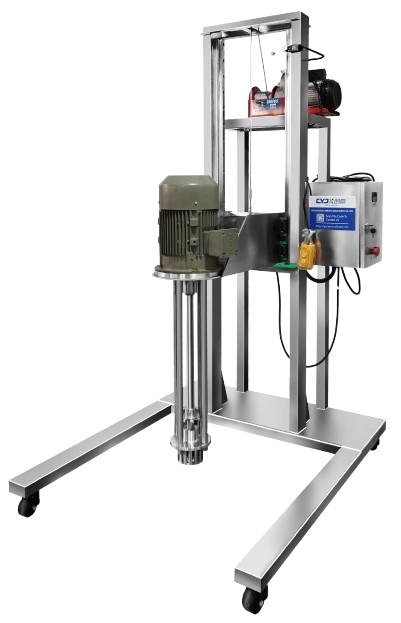
A high shear mixer uses a rotor-stator assembly to generate intense local shear forces. The rotor creates fluid movement through the mixing head, while the narrow working region produces mechanical action that helps disperse materials.
Depending on the design and operating conditions, this mechanism can improve powder incorporation, wetting, and the breakdown of some agglomerates.
Manufacturers may benefit from:
Faster incorporation of suitable powders.
More uniform pigment distribution.
Improved dispersion under appropriate processing conditions.
Reduced processing time for certain formulations.
Better process repeatability when operators maintain consistent parameters.
However, actual performance depends on the formulation, viscosity, equipment design, and target particle characteristics.
3.3 How Do Functional Additives Affect Ink Mixing?
Functional additives help ink achieve specific processing or application properties. Their selection also influences the manufacturing process.
Additive
Main function
Processing consideration
Humectants
Help retain moisture in suitable formulations
Addition sequence and compatibility
Defoamers
Help control unwanted foam
Dosage and mixing conditions
Biocides and bacteriostats
Help control microbial growth in suitable systems
Formulation compatibility and applicable regulations
Other functional additives
Adjust properties such as gloss or water resistance
Dispersion, compatibility, and final performance
Not every ink needs every additive. For example, a humectant may serve a particular purpose in some inkjet formulations, while another ink system may not require it.
The formulation team must select appropriate ingredients and determine suitable addition conditions. Mixing equipment supports the process, but it cannot replace formulation development or microbiological and performance testing.
3.4 Can a High Shear Mixer Replace a Milling Machine?
A high shear mixer and a milling machine serve different processing purposes.
A high shear mixer promotes mixing, wetting, and dispersion through intense mechanical action. A dedicated mill provides additional particle-size reduction or deagglomeration when the formulation requires it.
Some formulations may achieve their target properties through an optimized high shear process. Others still require milling to reach the specified fineness and performance.
Therefore, manufacturers should compare actual test results rather than assume that one machine can replace another in every application.
4. How to Choose the Right Industrial Mixer for Ink Manufacturing
The right equipment depends on the formulation, production scale, required processing conditions, and final product specifications. Three common equipment categories offer different capabilities.
A vacuum emulsifier homogenizer combines a mixing vessel with suitable agitation and homogenization components. Depending on its configuration, the system can also create a vacuum environment to help remove air from the product.
Potential applications include formulations that require intensive mixing, homogenization, and controlled deaeration.
Before selecting this equipment, manufacturers should evaluate:
Ink formulation and viscosity.
Batch capacity.
Required mixing and homogenization performance.
Vacuum requirements.
Temperature control needs.
Compatibility with the product and cleaning procedures.
A vacuum system can help control entrained air, but vacuum alone does not guarantee fine pigment dispersion.
An inline homogenizer processes material as it flows through a rotor-stator working head.
This configuration can support recirculation, continuous processing, or integration with a mixing tank. It may also suit production lines that require a compact arrangement or controlled material circulation.
Important selection factors include:
Required flow rate.
Operating pressure and pressure drop.
Product viscosity.
Number of circulation passes.
Piping and pump configuration.
Target dispersion performance.
The engineering team should evaluate the complete system rather than select an inline homogenizer solely by its nominal flow rate.
A batch high shear mixer processes material within a vessel or mixing container. Many designs use a rotor-stator assembly and may offer a stand, lifting mechanism, or other configuration options.
This equipment can suit batch formulations that require powder incorporation, dispersion, or intensive mixing.
When evaluating a batch mixer, manufacturers should consider:
Batch volume and vessel geometry.
Powder addition method.
Product viscosity.
Mixing head design and power.
Required processing time.
Compatibility with other mixing equipment.
Some formulations benefit from a combination of bulk agitation and high shear mixing rather than a single mixing mechanism.
4.4 When Does Ink Production Require Separate Milling Equipment?
Manufacturers should consider a dedicated milling stage when the formulation requires additional particle-size reduction or dispersion fineness beyond the capabilities of the selected mixer.
The decision depends on several factors:
Initial pigment particle characteristics and agglomeration.
Target fineness and particle-size distribution.
Formulation viscosity and composition.
Final printing requirements.
Results from mixing and dispersion trials.
A properly designed process may combine high shear mixing with milling, filtration, or other operations to meet the required specifications.
4.5 What Information Do You Need Before Selecting an Ink Mixer?
Before requesting a quotation, prepare the following information:
Ink type: Identify the product and its intended application.
Batch capacity: Specify the required processing volume.
Viscosity: Provide the expected viscosity range and relevant measurement conditions.
Raw materials: Explain whether the formulation uses pigments, dyes, powders, or liquid concentrates.
Dispersion requirements: State the target fineness or other measurable quality criteria.
Processing conditions: Identify heating, cooling, vacuum, and circulation requirements.
Production objectives: Describe the desired output and processing time.
Supporting equipment: Identify any requirements for pumps, filtration, storage tanks, or filling systems.
These details help the equipment supplier assess the application and propose a suitable configuration.
4.6 Which Mixing Equipment Fits Different Ink Production Needs?
Production requirement
Equipment or process to evaluate
Powder incorporation and pigment dispersion
Batch high shear mixer or inline high shear homogenizer
Air removal
Vacuum mixing or a suitable deaeration system
Additional particle-size reduction
Dedicated milling equipment
Continuous or recirculating treatment
Inline homogenizer and compatible piping system
Natural plant-color extraction
Extraction vessel, heating, agitation, and filtration equipment
This table provides an initial selection guide rather than a final engineering recommendation. A supplier should confirm the configuration through application review and, where appropriate, material testing.
5. What are the Advantages of Using Suitable Ink Mixing Equipment?
The right mixing system can improve processing performance, but the results depend on the formulation and operating conditions.
5.1 Improved Pigment Dispersion
Suitable mixing equipment helps wet and distribute pigment particles throughout the liquid phase. Better dispersion can support more consistent color and product appearance.
5.2 More Efficient Mixing and Processing
An appropriate mixer can reduce the time required to incorporate powders or achieve the target mixture quality. Manufacturers should compare actual processing times to quantify the improvement.
5.3 Better Powder Handling
A suitable rotor-stator design and powder addition method can help incorporate powders into the liquid phase and reduce the formation of persistent lumps.
5.4 More Consistent Production
Controlled mixing parameters, repeatable ingredient addition, and documented operating procedures can help manufacturers reduce batch variation.
5.5 Flexible Equipment Configurations
Depending on the production requirements, manufacturers may combine mixing vessels, high shear mixers, inline homogenizers, pumps, filtration equipment, and automated controls.
The goal is not simply to install a more powerful machine. Instead, the production team should select a system that meets the actual process requirements while balancing product quality, throughput, operating cost, and maintenance needs.
6. Industrial Mixing Solutions for Ink Manufacturing
CreWin / CYJX can use this section to introduce the equipment it actually supplies for suitable mixing and processing applications.
6.1 Match the Equipment to the Ink Formulation
Different ink formulations require different processing conditions. A pigment-based ink may need effective powder wetting and dispersion, while another formulation may prioritize liquid blending or air removal.
The project team should review the material properties and target specifications before recommending a machine.
6.2 Configure the Equipment Around Production Requirements
A suitable solution may depend on batch capacity, viscosity, processing time, temperature control, and downstream operations.
Depending on the project, the system may include mixing equipment, material transfer components, storage vessels, filtration, and other compatible auxiliary equipment.
6.3 Prepare the Information Needed for Equipment Selection
To help evaluate your project, provide the following details:
Ink type and intended application.
Existing manufacturing process.
Main raw materials and their physical properties.
Required batch capacity and production output.
Target dispersion fineness or other key quality requirements.
Requirements for vacuum, automation, and auxiliary equipment.
With this information, the engineering team can assess the process and determine whether a particular mixer or a combination of equipment offers a suitable solution.
6.4 Discuss Your Ink Manufacturing Requirements with CreWin / CYJX
Are you planning a new ink production line or looking to improve an existing mixing and dispersion process?
Share your ink type, batch size, raw material characteristics, and target product specifications with our team. These details will help us evaluate your requirements and discuss a suitable industrial mixing solution.
7. Frequently Asked Questions About Ink Manufacturing
7.1 How Is Printing Ink Manufactured?
Manufacturers select the ingredients, prepare the liquid carrier, incorporate the colorants, and mix or disperse the formulation. Depending on the ink type, they may also use milling, filtration, and additional finishing operations before quality control and packaging.
7.2 What Are the Main Ingredients in Ink?
Ink formulations commonly combine pigments or dyes, a liquid carrier, resins or binders, and functional additives. Certain printing ink systems also use varnish as a vehicle for pigment dispersion and to influence printing performance.
7.3 What Is Varnish in Ink Manufacturing?
Varnish typically combines resins, solvents, and selected additives in certain printing ink systems. It helps wet pigments, supports their incorporation into the formulation, and influences flow, adhesion, and film properties.
7.4 What Is the Difference Between Pigment-Based and Dye-Based Ink?
Pigment-based ink generally contains solid colorant particles dispersed in a carrier, whereas dye-based ink uses colorants that dissolve in a suitable medium. Their performance varies with the formulation, printing substrate, and intended application.
7.5 Why Do Manufacturers Add Functional Ingredients to Printer Ink?
Functional additives help ink achieve specific properties. For example, humectants can help retain moisture in suitable formulations, defoamers help control foam, and certain antimicrobial ingredients help control microbial growth. The formulation determines which additives the manufacturer needs.
7.6 What Equipment Do Manufacturers Use to Make Ink?
Depending on the formulation, manufacturers may use mixing tanks, high shear mixers, inline homogenizers, milling equipment, filtration systems, and filling equipment. The required configuration depends on the product and manufacturing process.
7.7 Can a High Shear Mixer Replace a Milling Machine?
Not in every application. A high shear mixer promotes wetting and dispersion, while a dedicated mill can provide additional particle-size reduction. Manufacturers should test the formulation against the required quality specifications before deciding whether they can omit a milling stage.
7.8 How Can Manufacturers Improve Ink Batch Consistency?
Manufacturers can improve consistency by controlling raw material quality, ingredient proportions, addition sequence, mixing conditions, processing time, and quality testing. Appropriate equipment and repeatable operating procedures also support consistent production.
7.9 How Is Natural Ink Made from Plants?
Natural ink makers typically select suitable plant materials, extract color through soaking or heating, strain the liquid, and add a compatible binder when necessary. However, natural ink recipes vary, and homemade formulations do not automatically provide the stability or performance required for industrial printing.
Conclusion
Understanding how ink is made requires more than knowing the ingredients. Manufacturers must also understand how colorants interact with the liquid carrier, how mixing and dispersion influence product quality, and when additional processing equipment becomes necessary.
A suitable industrial mixer can help improve powder incorporation, pigment dispersion, and processing efficiency. However, the best solution depends on the formulation, required particle characteristics, batch capacity, and final application.
By evaluating these factors before equipment selection, ink manufacturers can develop a more appropriate production process and make better-informed investment decisions.
If you are evaluating mixing equipment for ink production, start with your formulation, target specifications, and production requirements. These details provide the foundation for selecting equipment that supports your manufacturing objectives.

 ZS Lab Vacuum Emulsifying Mixer
 ZEx Ex-Proof Vacuum Homogenizer Mixer without Hydraulics
 ZA Lab Vacuum Homogenizer
 ZB Vacuum Homogenizer Emulsifier without Hydaulics
 ZB Simplified Vacuum Homogenizer Mixer
 ZA Vacuum Homogenizer Mixer without Hydraulics
 ZS Vacuum Emulsifying Mixer
 ZB Vacuum Homogenizer Emulsifier